


Have you ever come across images where the moon looks big, like really really big? Looks fascinating right? But, when you point your smartphone towards the sky, it’s nothing more than mere disappointment. And the situation doesn’t improve much even when you use your camera with an everyday lens. So how can you take such pictures? You actually don’t have to wait for the supermoon to take such images really. All you need is some planning and the right equipment.
Related: deal ending soon for the Milky Way Photo Guide  Summer Nights Sale

Captured by Ganapathy Kumar, Nikon D7000, 600mm lens
Use a lens with a long focal length
If you want the moon to appear big, you’ll need to use a big chunk of glass yourself. And for this purpose, even something like a 200mm will fall short. Go for something in the range of 400mm and above. Longer the focal length, narrower will be your field of view, making the moon appear bigger and closer. These types of lenses can be quite expensive so renting one for a short time to try it out might be a good option.
Get a teleconverter
If you feel that your lens is not long enough, and if getting another one is not an option, consider using a teleconverter. They come at a fraction of the price and yet increase your reach drastically. For instance, by using a 2x teleconverter, your 400mm lens will act as an 800mm lens.
Consider crop sensors
Crop sensor cameras can also be an option for increasing your reach. For instance, if you use a 400mm lens on an APS-C Canon body, the crop factor of 1.6 means that the crop sensor will be able to form an image that’s the equivalent of a 400×1.6 = 640mm lens. And that’s without using any teleconverters.
The rule of 100
Consider that you want to take an image with an interesting subject superimposed over the moon, while the moon appears roughly the same size of the subject. This is where the ‘rule of 100’ comes into play. In the aforementioned case, if the subject is of size D, you must shoot from a distance of 100D. This will cause the moon to appear as the same size as the subject.
For instance, if you have a subject that’s 5m wide, for the moon to appear 5m wide, you’d have to shoot from a distance of 100×5 = 500m from the subject.
Shoot when the moon is low
You’ll be able to get an interesting perspective when photographing the moon while it is low in the sky. This gives you an opportunity to compose with interesting landscapes and cityscapes in the foreground. Doing so will also give viewers a sense of scale and make them realize how big the moon is appearing in your image.
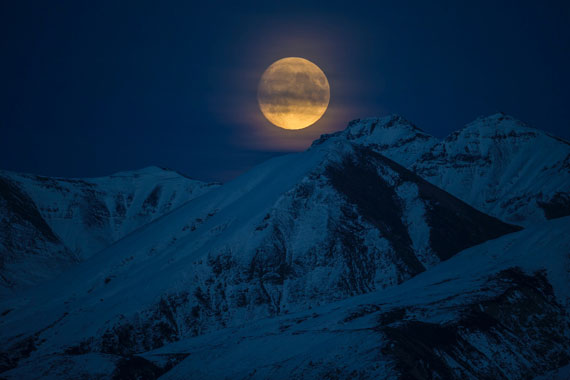
Photo captured by Jonathan Wheeler, 500mm
Use a tripod
Things get shaky with longer focal length. Even the slightest movement will get amplified and make it difficult for you to even compose the shot. It is thus a good idea to use a good tripod when working with long lenses. When using a tripod, be sure to switch off the stabilization in your camera and lens.
Camera settings
As the moon itself is bright, consider using low ISO values. Use a narrow aperture like f/8 for a good mix of depth and sharpness. And since the moon isn’t running away anywhere that fast, adjust your shutter speed based on the ISO and aperture you’re using. Be aware that the difference in luminosity can cause the foreground to appear dark. Either use it to your benefit to take images with silhouette, or take multiple exposures and work in post to bring a balance in brightness between the moon and the foreground.
For Further Training on Night Photography:
If you want a simple, field-ready way to master night photography, the Milky Way Photography Field Guide breaks it down step-by-step.
Inside, you’ll learn when the Milky Way is visible, where to look, how the galactic core moves across the sky, which camera settings to use, and photo editing tricks.
Right now, it’s part of our Summer Nights Sale—timed perfectly for the months when most photographers start planning their Milky Way shoots.
Deal ending soon: Milky Way Photography Guide Summer Nights Sale
from PictureCorrect https://ift.tt/xtdsOkR
via IFTTT


0 kommenttia:
Lähetä kommentti