


Few things create more tension among photographers than a prime tripod spot at the right moment.
Whether it’s a solar eclipse, fireworks show, sunrise over a famous landmark, or a rare natural phenomenon, these moments attract crowds — and with them, unspoken rules about space, timing, and respect. Unfortunately, those rules aren’t always followed.
This post isn’t about calling anyone out. It’s about setting expectations, reducing frustration, and helping photographers share limited space without ruining the experience for others.
Reminder: only 1 day left for the Fireworks Photo Guide New Year’s Eve Sale
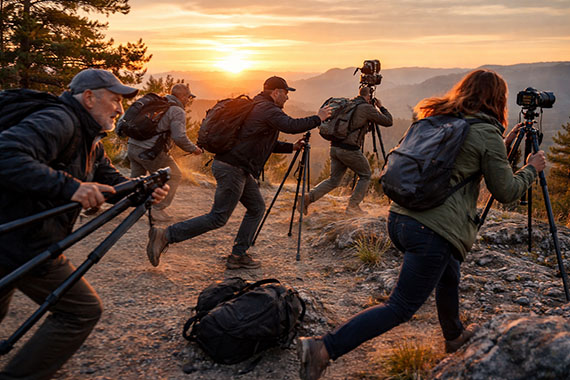
The Reality of High-Demand Photo Moments
When a popular event is about to happen, three things are almost guaranteed:
- Space is limited
- Emotions are high
- Everyone believes their shot matters
Add tripods into the mix, and small decisions can quickly turn into big frustrations.
Common scenarios include:
- Tripods placed hours in advance with no photographer in sight
- Late arrivals setting up directly in front of others
- Gear slowly expanding into neighboring space
- Arguments over who “was there first”
Most of these issues come down to one thing: unclear etiquette.
The Big Question: Can You “Reserve” a Tripod Spot?
Short answer: sometimes — but with limits.
Placing a tripod to mark a spot can be reasonable only if you stay nearby and return promptly. A tripod left unattended for long periods, especially in crowded public spaces, crosses from courtesy into entitlement.
A good rule of thumb:
- If you wouldn’t feel comfortable explaining it face-to-face, it probably isn’t okay.
A tripod is not a lawn chair at a parade — and even those come with social expectations.
Arriving Late: The Blocking Problem
Another common source of tension happens when photographers arrive late and try to squeeze in.
This often looks like:
- Setting up directly in front of seated or kneeling photographers
- Raising a tripod higher than everyone else’s
- Slowly edging forward “just a little” at a time
Even if the view looks open, someone behind you may already be framed and focused. Blocking another photographer’s composition — intentionally or not — can instantly sour the mood.
If you arrive late:
- Look for gaps, not front-row takeovers
- Ask before setting up near others
- Accept that the best spots may already be taken
Sometimes the right move is shooting handheld, adjusting your angle, or simply enjoying the moment.
Space Creep: The Silent Offense
Tripods tend to grow.
A bag here, a second camera there, legs slowly widening — before long, one photographer occupies the space of three. In tight locations, this “space creep” is one of the most common — and least acknowledged — problems.
Be mindful of:
- How wide your tripod legs are
- Where your bag is placed
- Whether others still have room to adjust
Small awareness goes a long way.
Courtesy Goes Further Than Rules
There’s no official handbook for tripod etiquette, but a few simple behaviors make a huge difference:
- Communicate — a quick “Mind if I set up here?” prevents most issues
- Stay present — don’t reserve space and disappear
- Be flexible — the shot isn’t worth ruining someone else’s experience
- Remember the crowd — photographers are part of the audience, not separate from it
Ironically, the photographers who show the most courtesy often end up with better shots — fewer distractions, better cooperation, and a calmer environment.
When You’re the One Being Blocked
Even with good etiquette, problems still happen.
If someone blocks your shot:
- Speak up early, politely, and clearly
- Assume ignorance before malice
- Avoid public confrontations when possible
Most photographers don’t want to be “that person.” Often, they simply didn’t notice.
The Bottom Line
Great photos don’t just come from good light and timing — they come from good behavior.
In crowded moments, tripod etiquette matters as much as camera settings. Respecting space, staying aware of others, and being willing to adapt helps everyone walk away with better images — and fewer regrets.
Because no photograph is improved by an argument behind the camera.
For Further Training on Fireworks Photography:
Fireworks photography is indeed one of the most daunting types of photography. This in-depth tutorial eBook explains the process from start to finish, everything from gear and camera settings to composition and post-processing to achieve great results with fireworks of any kind. It is currently 55% off to help photographers prepare for the New Year’s Eve fireworks shows!

The How to Photograph Fireworks eBook
A common result of photographers new to fireworks photography is capturing nothing but bright white spots instead of colorful bursts. But with the guidance of this eBook in hand, you should be fully prepared to photograph brilliant fireworks displays.
Only 1 day left: How to Photograph Fireworks Guide at 55% Off
from PictureCorrect https://ift.tt/pO6cieJ
via IFTTT


Really interesting perspective on when it’s okay to break the rules in photography! I love how you explained creative exceptions like intentional motion blur and off-center compositions. For others who want to read more about breaking traditional rules and improving creative outcomes, this guide was super helpful too Phephotos https://phephotos.com/
VastaaPoista