


When planning a night of Milky Way photography, most photographers check the cloud forecast first. But some astronomy weather apps also display two less familiar measurements: seeing and transparency.
They may sound similar, but they describe very different atmospheric conditions—and one is usually much more important for photographing the Milky Way.
September 10 New Moon Reminder: The darker skies around the new moon create one of the month’s best opportunities to photograph the Milky Way—and there’s only a little while left to save during the Milky Way Photo Guide  Summer Finale Sale.
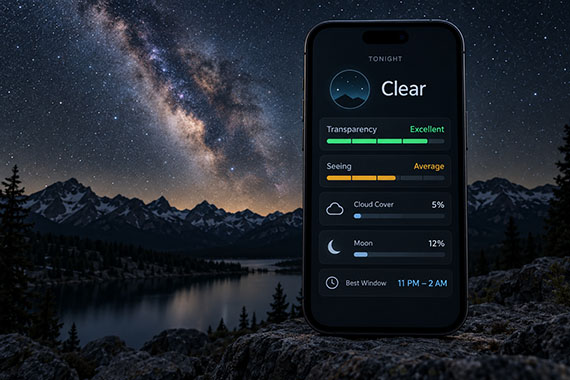
What Is Atmospheric Seeing?
“Seeing” describes the stability of the atmosphere.
As layers of air with different temperatures move above you, they bend light in slightly different directions. This turbulence can make stars appear to shimmer, wobble, or blur when viewed at high magnification.
Poor seeing is especially troublesome for:
- Planetary photography
- Lunar close-ups
- Double-star observation
- Long-focal-length astrophotography
- Telescope imaging
That is why planetary photographers pay close attention to seeing forecasts. Even beneath a perfectly clear sky, turbulent air can make fine details on Jupiter or the Moon look soft.
For wide-angle Milky Way photography, however, seeing is usually much less important. Individual stars occupy only a tiny portion of the frame, and atmospheric turbulence is rarely the main factor limiting sharpness.
Your focus accuracy, shutter speed, lens quality, and tracking precision will generally matter far more.
What Is Transparency?
Transparency describes how clearly light can pass through the atmosphere.
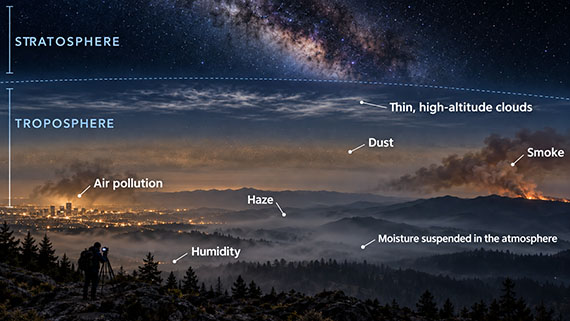
A sky can be completely free of clouds yet still have poor transparency because of:
- Humidity
- Haze
- Smoke
- Dust
- Air pollution
- Thin, high-altitude clouds
- Moisture suspended in the atmosphere
These particles scatter light and reduce contrast. They can also amplify the glow from nearby towns, making the sky look brighter and washing out the Milky Way’s faint structure.
Good transparency allows more starlight to reach your camera. The result is usually a darker background sky, stronger contrast, clearer dust lanes, and better definition in the galactic core.
For most Milky Way photographers, transparency is the more useful forecast.
Clear Skies Don’t Always Mean Transparent Skies
This is where many photographers get caught out.
A standard weather forecast may show clear skies all night, but “clear” generally means there will be little or no measurable cloud cover. It does not necessarily mean the atmosphere will be clean, dry, and transparent.
You might arrive at your location and find that the stars are visible, yet the Milky Way looks weak and muddy. The culprit may be high humidity, wildfire smoke, dust, or a thin layer of haze.
This is particularly noticeable near the horizon, where you are looking through much more atmosphere. If the galactic core is low in the sky, poor transparency can obscure it even when conditions overhead appear reasonably clear.
Which Forecast Should You Prioritize?
For wide-field Milky Way photography, check conditions in roughly this order:
- Cloud cover: Will the sky actually be open?
- Transparency: Will haze, smoke, or moisture reduce contrast?
- Moonlight: Will the Moon brighten the sky during your planned session?
- Humidity and dew point: Is condensation likely to form on your lens?
- Seeing: Mostly important if you are also using a telescope or long focal length.
A night with excellent transparency and mediocre seeing can still be wonderful for photographing the Milky Way.
A night with excellent seeing but poor transparency may produce disappointing wide-angle images.
When Does Seeing Matter to Milky Way Photographers?
Seeing becomes more relevant when you move beyond traditional wide-angle compositions.
You may want to check it more carefully if you are:
- Photographing small deep-sky objects at long focal lengths
- Using a telescope or telephoto lens
- Capturing highly magnified Moon or planet images
- Trying to resolve extremely fine star detail
- Shooting detailed tracked panoramas with longer lenses
Even then, seeing is only one part of the equation. Wind, tracking accuracy, focus, equipment temperature, and optical quality can all affect the final result.
A Practical Forecasting Strategy
Don’t depend on a single “clear sky” icon. Compare several pieces of information before committing to a location.
Look at cloud cover at different altitudes, predicted transparency, humidity, dew point, wind, smoke maps, and the Moon’s position. It can also help to check nearby live cameras or recent satellite imagery shortly before leaving.
Remember that forecasts are estimates. Local valleys, marine layers, wildfire smoke, and changing winds can create conditions that broad regional forecasts miss.
The Simple Answer
If you photograph the Milky Way with a wide-angle lens, transparency matters more than seeing.
Seeing tells you how steady the atmosphere is. Transparency tells you how much faint galactic detail may actually reach your camera.
The ideal night offers clear skies, excellent transparency, low humidity, little moonlight, and manageable wind. But if you must choose between excellent seeing and excellent transparency, the more transparent sky will usually give you the stronger Milky Way photograph.
Don’t Miss the Last Milky Way Opportunity of the Season:
If photographing the Milky Way has been sitting on your summer photography list, September is giving you one more excellent opportunity.
The new moon arrives on September 10, 2026, creating several evenings with very little moonlight to interfere with the night sky. For photographers across much of the Northern Hemisphere, this is also one of the last really convenient opportunities of the summer to photograph the bright Galactic Core.
If you want a simple, field-ready way to master night photography, the Milky Way Photography Field Guide breaks it down step-by-step.
Inside, you’ll learn when the Milky Way is visible, where to look, how the galactic core moves across the sky, which camera settings to use, and photo editing tricks.
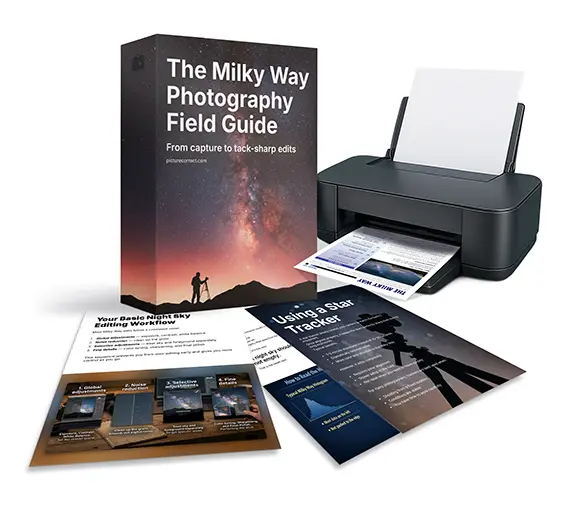
Right now, it’s part of our Summer Finale Sale—timed perfectly for the months when most photographers start planning their Milky Way shoots.
Deal ending soon: Milky Way Photography Guide Summer Finale Sale
from PictureCorrect https://ift.tt/mOH2kpr
via IFTTT


0 kommenttia:
Lähetä kommentti