


Most meteor showers require photographers to stay awake until the early morning hours. The Draconid meteor shower, peaking around October 8, 2026, is different. Its best viewing opportunities often come during the evening, shortly after the sky gets dark.
That makes it an excellent opportunity to practice meteor photography without staying up all night.
Related: only a little while left for the Milky Way Photo Guide  Clear Skies Sale
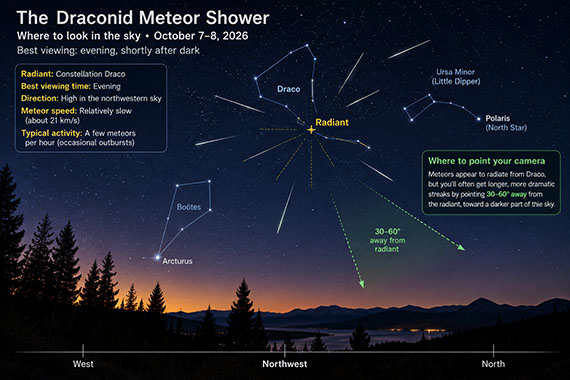
What Makes the Draconids Special?
The Draconids originate from debris left behind by Comet 21P/Giacobini-Zinner. Each October, Earth passes through this debris, producing streaks of light as small particles burn up in our atmosphere.
Unlike faster meteor showers, Draconid meteors travel relatively slowly, at approximately 21 kilometers per second. Their radiant is located in the constellation Draco, which is favorably positioned during the evening for observers in the Northern Hemisphere.
The shower typically produces only a handful of meteors per hour, although occasional outbursts have occurred.
The good news for 2026: With the new moon approaching on October 10, moonlight should interfere very little with viewing.
The Draconids are best viewed from the Northern Hemisphere, including North America, Europe, and much of Asia. Observers near the equator may also catch a few meteors, but viewing becomes increasingly difficult farther south. The shower is generally not visible south of 40° south latitude.
Best Camera Settings for the Draconids
A DSLR or mirrorless camera, wide-angle lens, and sturdy tripod are all you need to get started.
- Camera mode: Manual
- Aperture: f/1.8–f/2.8
- Shutter speed: 10–15 seconds
- ISO: 1600–3200
- Focus: Manual, on a bright star
- File format: RAW
- Shooting mode: Continuous interval shooting
Use a wide-angle lens, ideally 14–24mm on a full-frame camera, to capture as much sky as possible.
Although the meteors appear to originate from Draco, try pointing your camera about 30–60 degrees away from the radiant. This can produce longer, more dramatic meteor streaks.
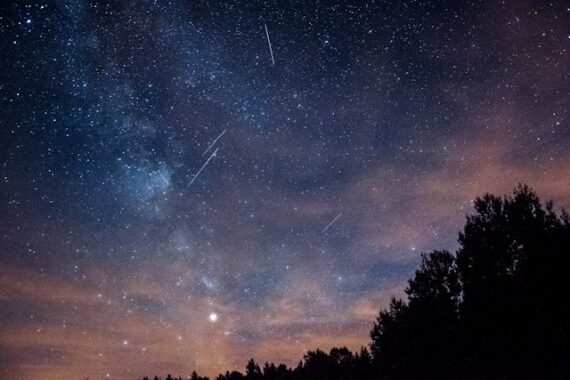
Photo captured by Michał Mancewicz. 18mm, f/3.5, 15 seconds, ISO 3200
The Secret: Keep Your Camera Shooting
Don’t wait until you see a meteor to press the shutter. By then, it’s usually too late.
Instead, use an intervalometer or your camera’s built-in interval shooting feature to capture exposures continuously.
For example, taking 15-second exposures for an hour could produce approximately 240 photographs. Most won’t contain meteors, but you only need one good streak to create a memorable image.
A few additional tips:
- Find dark skies: Avoid city lights whenever possible.
- Focus carefully: Magnify a bright star in Live View and adjust manually.
- Disable long-exposure noise reduction: This prevents lengthy pauses between photographs.
- Include a foreground: Trees, mountains, or interesting landscapes make meteor photographs more compelling.
Don’t Miss This Evening Opportunity
The Draconids aren’t usually the most active meteor shower of the year, but their convenient timing makes them particularly appealing to photographers.
Head outside on the evening of October 8, set up your camera shortly after darkness falls, and let it capture a continuous sequence of exposures.
Even if you only photograph one meteor, a well-composed image beneath the October night sky can make the effort worthwhile.
For Further Training on Night Photography:
If you want a simple, field-ready way to master night photography, the Milky Way Photography Field Guide breaks it down step-by-step.
Right now, it’s part of our Clear Skies Sale—timed perfectly for the months when most photographers start planning their Milky Way shoots.
Deal ending soon: Milky Way Photography Guide Clear Skies Sale
from PictureCorrect https://ift.tt/jySRmfT
via IFTTT


0 kommenttia:
Lähetä kommentti