


Have you ever taken a 30-second long exposure, only to discover your camera needs another 30 seconds before you can take the next photo? Your camera isn’t malfunctioning. It’s probably performing a process called Long Exposure Noise Reduction (LENR).
This setting can improve image quality in certain situations, but it comes with a significant trade-off: it can effectively double the time required for every photograph.
Reminder: offer ending soon for the Long Exposure Field Guide  Autumn Afterglow Sale
What Is Long Exposure Noise Reduction?
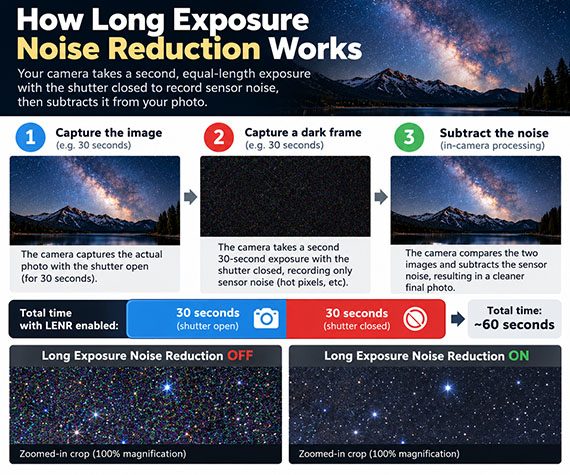
During long exposures, a camera’s sensor can produce unwanted noise, particularly as the sensor warms up. This often appears as tiny bright or colored dots called hot pixels, which become especially noticeable in night photography.
Long Exposure Noise Reduction addresses this problem using a technique called dark-frame subtraction.
Here’s what happens when you take a 30-second exposure:
- First 30 seconds: Your camera captures the actual photograph.
- Next 30 seconds: Your camera takes another exposure of equal duration with the shutter closed, recording sensor noise rather than light.
- Processing: The camera uses this dark frame to identify and subtract much of the unwanted noise from your photograph.
The result can be a cleaner image, but your 30-second photograph now takes approximately 60 seconds to complete.
For a 4-minute exposure, you could be waiting roughly 8 minutes before the camera is ready again.
When Should You Turn It On?
Long Exposure Noise Reduction can be particularly useful when photographing:
- Night landscapes: Long exposures where hot pixels become distracting.
- Star trails: Extended exposures that can reveal sensor-related noise.
- Low-light scenes: Especially when using a camera prone to hot pixels.
However, dark-frame subtraction primarily targets repeatable sensor noise, such as hot pixels and thermal patterns. It doesn’t eliminate all high-ISO noise or the random grain caused by limited light.
When Should You Turn It Off?
There are situations where the extra waiting time can cost you valuable photographs.
Milky Way photography: If you’re capturing multiple images to stack later, doubling the time between shots can slow down your session considerably. Dark-frame calibration can also be performed separately during post-processing.
Meteor showers: While your camera is busy capturing a dark frame, it cannot photograph incoming meteors. You could miss half the available shooting time.
Changing light: During blue hour, sunsets, or rapidly changing weather, waiting several minutes between photographs may mean missing the best conditions.
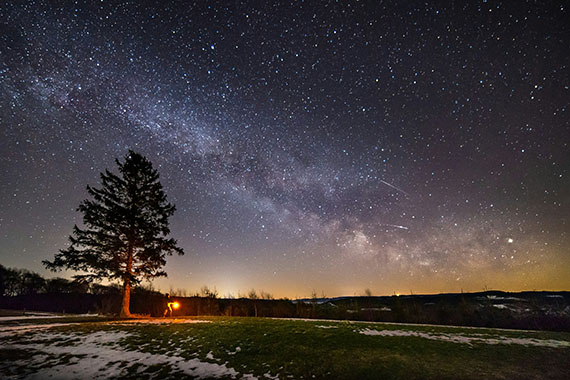
25 second exposure captured by Evgeni Tcherkasski
Does It Actually Improve Image Quality?
Yes, but the improvement depends on your camera, exposure length, and shooting conditions.
Modern sensors often handle long exposures remarkably well, and some cameras automatically suppress hot pixels even when dedicated Long Exposure Noise Reduction is disabled.
For many photographers, the best approach is to experiment. Take two identical long exposures, one with the setting enabled and one without. Compare them at 100% magnification, particularly in dark areas of the image.
You may discover that the difference is barely noticeable—or that the setting makes a substantial improvement.
The Bottom Line
Long Exposure Noise Reduction isn’t necessarily something you should leave enabled all the time.
If you’re photographing a stationary landscape and have plenty of time, the extra processing may be worthwhile. But if you’re capturing meteors, shooting a sequence of images, or working with rapidly changing light, turning it off can dramatically improve your shooting efficiency.
The key is understanding what your camera is doing during that extra waiting time—and deciding whether the improvement is worth it.
Want to Master Long Exposure Photography?
Understanding noise reduction is just one part of creating stunning long exposure photographs. Our new Long Exposure Photography Guide & Cheat Sheets (currently 70% off today for our Autumn Afterglow Sale) walks you through everything from choosing ND filters and camera settings to photographing waterfalls, oceans, clouds, and nighttime scenes.

Our Long Exposure Photography Guide walks you through the techniques and camera settings needed to create beautiful long exposures, from silky waterfalls and dramatic clouds to nighttime cityscapes and more.
Deal ending soon: The Long Exposure Photography Guide at 70% Off
from PictureCorrect https://ift.tt/OwGbcgY
via IFTTT


0 kommenttia:
Lähetä kommentti