


Low-light photography frustrates a lot of photographers for the same reason: the photos don’t come out the way they looked in real life.
They’re either blurry, noisy, or too dark. Sometimes all three.
Related: Want to master advanced techniques faster? PictureCorrect Premium is designed to be an accelerator with lessons, exercises, and more — and it’s only $1 to try this weekend
And when that happens, most people assume the problem is their camera, their lens, or the lighting conditions.
But in many cases, it comes down to a single setting:
Shutter speed.
Why Shutter Speed Matters More Than You Think
In low light, your camera is struggling to gather enough light to properly expose the scene. That means one thing has to give.
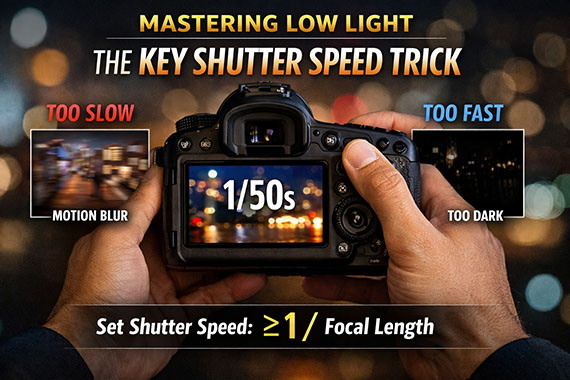
If your shutter speed is too fast, your image will be underexposed (too dark).
If it’s too slow, you’ll introduce motion blur—even if your hands feel steady.
This is where things start to fall apart for a lot of photographers.
They lower the shutter speed just enough to brighten the image… but not enough to stay sharp.
The result? A photo that looks “off” in a way that’s hard to explain.
The Hidden Limit of Handheld Shooting
Every photographer has a limit to how slow they can handhold a camera without introducing blur.
A simple rule of thumb:
Your shutter speed should be at least 1 over your focal length.
So if you’re shooting at:
- 50mm → aim for at least 1/50s
- 100mm → aim for at least 1/100s
- 200mm → aim for at least 1/200s
This isn’t a strict rule, but it’s a reliable baseline.
Go below it, and your chances of motion blur increase quickly—even if your subject isn’t moving.
And if your subject is moving? You’ll need an even faster shutter speed.
Why Most Low-Light Photos Go Wrong
Here’s what typically happens:
You’re in a low-light scene—maybe indoors, at sunset, or in a city at night.
You lower your shutter speed to brighten the image…
But you don’t realize you’ve crossed your personal stability limit.
So even though the exposure looks better, the image loses sharpness.
To compensate, many photographers then raise ISO too much, introducing noise.
Or they open the aperture fully, losing depth of field.
Now you’re juggling trade-offs without a clear system—and the results become inconsistent.
A Simple Way to Improve Immediately
Next time you’re shooting in low light, do this:
Start by setting your shutter speed to a safe handheld value based on your focal length.
Lock that in first.
Then adjust your exposure using aperture and ISO instead of letting shutter speed drift too low.
This one change alone can dramatically improve your results.
Your photos may still have some noise—but they’ll be sharp. And sharp photos are almost always easier to fix than blurry ones.
But This Is Only Part of the Picture
Shutter speed is just one piece of a much bigger system.
Because in real-world low-light situations, you’re constantly balancing three competing factors:
- Motion (your movement and your subject’s movement)
- Noise (from increasing ISO)
- Exposure (how bright the image needs to be)
And knowing which to prioritize—and when—is what separates consistent results from guesswork.
Take Control of Low-Light Photography
Inside the PictureCorrect Premium newsletter (only $1 to try this weekend), this is expanded into a complete low-light workflow.
An exercise walks through exactly how to:
- Choose the right shutter speed for any situation
- Balance ISO, aperture, and motion without guessing
- Handle moving subjects in low light
- Get sharp, clean images even in challenging conditions

Instead of trial and error, you’ll have a clear system you can apply every time you pick up your camera.
Low light doesn’t have to be unpredictable.
Once you understand how to control shutter speed—and how it fits into the bigger picture—you’ll start getting results that actually match what you saw.
Deal ending soon: Special Premium Enrollment This Weekend
from PictureCorrect https://ift.tt/Gvn0wFy
via IFTTT


0 kommenttia:
Lähetä kommentti