


Autofocus technology has become incredibly sophisticated, but busy environments can still confuse even the most advanced camera systems. Whether you’re photographing a crowded street market, a lively festival, or a bustling city square, your camera may struggle to decide what exactly to focus on. This is where understanding the difference between Single-Point AF and Wide AF becomes especially valuable for travel photographers.
Choosing the right autofocus mode can make the difference between a sharp subject and a missed moment.
Related note: only a little while left for the Travel Photography Cheat Sheets at 88% Off!
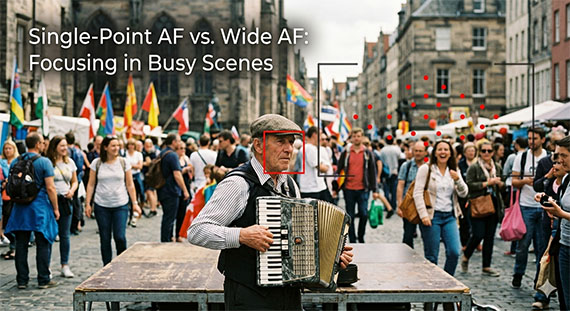
Understanding Single-Point Autofocus
Single-Point AF allows the photographer to manually select one specific focus point within the frame. The camera will only attempt to focus on whatever is directly under that point.
In busy environments, this level of control can be extremely useful. Instead of letting the camera guess which object should be sharp, you explicitly tell it where to focus.
For example, imagine photographing a street performer in a crowded plaza. With wide autofocus, the camera might lock onto a passerby in the foreground or a sign in the background. With single-point AF, you can place the focus point directly on the performer’s face and ensure that the subject you care about remains sharp.
Advantages of Single-Point AF
- Precise control over what the camera focuses on
- Ideal for isolating a subject in cluttered scenes
- Reduces the risk of the camera focusing on the wrong object
- Works well for portraits, architecture details, and street photography
Potential Drawbacks
Single-point focusing can be slower when subjects move quickly. If your subject shifts position, you may need to reposition the focus point or recompose the frame.
Understanding Wide Autofocus
Wide AF (sometimes called Auto-Area AF or Wide-Area AF depending on the camera brand) allows the camera to evaluate many focus points across the frame and decide where to focus automatically.
Modern cameras often combine this mode with subject detection or eye-tracking, which can make it surprisingly effective for photographing people.
In travel photography, this can be helpful when capturing spontaneous moments—such as children running through a fountain or cyclists passing through a market street—where there simply isn’t time to manually place a focus point.
Advantages of Wide AF
- Faster for unpredictable or moving subjects
- Useful when shooting quickly or reacting to fleeting moments
- Works well with modern face and eye detection systems
Potential Drawbacks
In crowded scenes, the camera may focus on something you didn’t intend—such as a nearby object, background detail, or a person walking through the frame.
When Busy Scenes Cause Autofocus Problems
Busy travel environments often contain several elements competing for focus:
- People walking through the frame
- Signs, poles, or architectural details
- Foreground objects like fences or plants
- High-contrast patterns that attract autofocus
Because autofocus systems tend to lock onto the nearest object or the highest contrast area, the camera’s choice may not match the photographer’s intent.
This is why experienced travel photographers often switch between autofocus modes depending on the situation rather than relying on a single setting all day.
Practical Situations and Which Mode Works Best
Crowded Street Scenes
Single-Point AF usually performs best. It allows you to lock focus precisely on a specific person or subject among the crowd.
Fast Action or Movement
Wide AF is typically more effective, especially when combined with continuous autofocus tracking.
Architecture in Busy Locations
Single-Point AF helps prevent the camera from focusing on people walking in front of the building you’re photographing.
Festivals and Events
Wide AF can be helpful for capturing spontaneous moments quickly, particularly if your camera has reliable face detection.
A Useful Travel Photography Strategy
Many photographers adopt a simple approach when working in busy locations:
- Start with Wide AF when moving quickly through a scene.
- Switch to Single-Point AF when you have time to compose a shot carefully.
Learning how to toggle between autofocus modes quickly—often using a customizable camera button—can dramatically increase your hit rate in chaotic travel environments.
The Bottom Line
Busy environments challenge autofocus systems because there are simply too many potential subjects competing for attention. Single-Point AF provides precision and control, making it ideal when you want to isolate a specific subject. Wide AF offers speed and convenience, helping you capture spontaneous moments before they disappear.
Travel photographers who understand both modes—and know when to switch between them—will consistently capture sharper, more intentional images, even in the most crowded destinations.
For Further Training:
Some shots are just harder than others. Ever struggled with Milky Way photos, twilight exposures, or star trails and focus stacking while you’re on the move? The Travel Photography Cheat Sheets (currently 88% off today) are built exactly for moments like that:

Showing you step by step how to dial in settings, avoid common mistakes, and get the shot — even when you’re tired, rushed, or shooting in unfamiliar conditions. Travel-ready, no Wi-Fi required, and designed to be quick to reference so you can spend less time guessing and more time shooting.
Deal ending soon: Travel Photography Cheat Sheets at 88% Off
from PictureCorrect https://ift.tt/Lqv7alM
via IFTTT


0 kommenttia:
Lähetä kommentti