


One of the fastest ways to improve your photography isn’t learning a new camera feature—it’s learning how to see. This exercise removes obvious subjects entirely and forces your attention onto texture, light, and composition. By stripping away recognizable objects, you train your eye to notice visual qualities that often get overlooked when you’re focused on “what” you’re photographing instead of how it looks.
Texture photography is especially effective during winter months, when surfaces like ice, frost, and worn materials naturally reveal detail and contrast. But the skill you build here applies year-round, across every genre of photography.
Relevant note: only a little while left for the Photography Exercises  Winter Sale
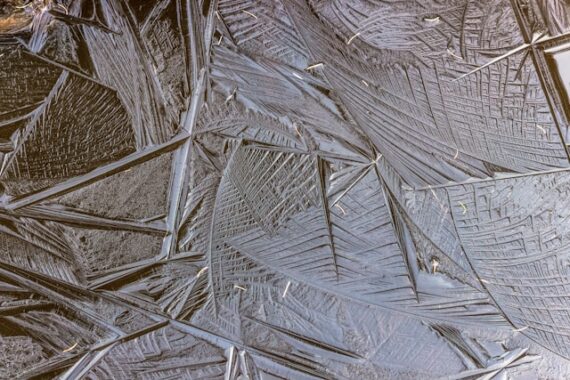
The Goal of the Exercise
The purpose of this exercise is simple: train your eye for detail. You’re learning to recognize strong compositions based on texture, tone, pattern, and light—without relying on a clear subject to carry the image.
When you remove obvious context, every decision matters more:
- Where light falls
- How shadows create depth
- How lines and patterns guide the eye
These are the same skills that elevate landscapes, portraits, and street photography—but here, they’re isolated and strengthened.
What to Photograph
Look for surfaces that naturally reveal texture when viewed up close. Good starting points include:
- Ice or melting frost
- Road salt on pavement
- Cracked sidewalks or asphalt
- Wool, knit fabric, or heavy coats
- Tree bark, weathered wood, or stone
These subjects are everywhere, but the key is how you photograph them—not what they are.

How to Shoot It
Move in close. Very close.
Your goal is to make the surface itself the subject, removing any visual clues that explain what the viewer is looking at. Think abstract rather than documentary.
Rules to Follow
- Fill the frame completely
No empty space, no background context. Let texture dominate. - Avoid recognizable objects unless intentional
If the viewer instantly knows what the object is, you’re probably too far away. If recognition happens only after a second look, you’re on the right track.
Pay attention to:
- Direction of light (side light reveals texture best)
- Micro-contrast between highlights and shadows
- Repeating patterns or subtle irregularities
Camera and Lens Tips
You don’t need specialized gear for this exercise, but a few choices can help:
- Use a macro lens if you have one, or the closest-focusing lens you own
- Stop down slightly (around f/8–f/11) to retain texture depth
- Use manual focus if autofocus struggles with low contrast
- A tripod helps when working very close or in low light
Smartphone photographers can do this exercise just as effectively—use the phone’s closest lens and move slowly until texture snaps into clarity.
Why This Exercise Works
This exercise strengthens several core photography skills at once:
Macro and close-focus control
You learn how small changes in distance and angle dramatically affect detail.
Composition without obvious subjects
Without a clear focal point, balance, rhythm, and visual flow become essential.
Better photo editing later
When you learn to see subtle tonal differences in-camera, you naturally become more restrained and intentional in post-processing—avoiding over-sharpening, excessive clarity, or heavy-handed contrast.
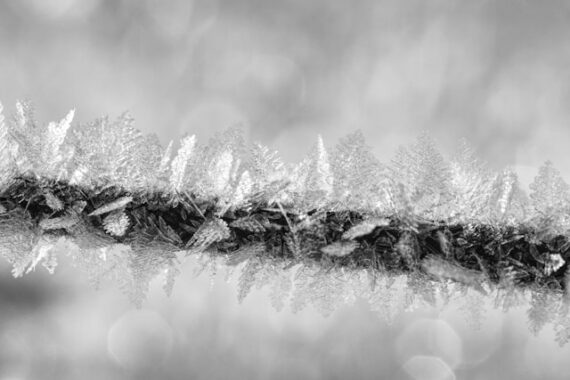
How to Review Your Results
After shooting, don’t ask, “What is this a photo of?”
Ask instead:
- Does the texture feel tactile?
- Is the frame visually balanced?
- Does light enhance or flatten the surface?
- Would this image still work in black and white?
The strongest images from this exercise often feel timeless and abstract—more about sensation than subject.
Final Thought
Texture photography teaches you to slow down and notice what’s right in front of you. When you return to more traditional subjects, you’ll find that your compositions are stronger, your use of light more deliberate, and your editing more subtle.
Seeing texture is seeing photography at its foundation.
If you want more exercises like this—clearly structured, easy to follow, and designed to build real shooting instincts—the Winter Sale on the Photography Exercises is wrapping up soon. It’s a practical way to keep improving, even when winter limits your time and motivation to shoot.

A practical way to build confidence for challenging shooting situations that often trip photographers up. Each exercise focuses on real-world scenarios—difficult light, motion, exposure decisions, and creative problem-solving—so you learn how to take control instead of relying on auto settings.
Deal ending soon: PictureCorrect Photography Exercises Winter Sale
from PictureCorrect https://ift.tt/GKC3M60
via IFTTT


0 kommenttia:
Lähetä kommentti