


Most photographers develop an editing workflow without giving much thought to the order of their adjustments.
Exposure first. Contrast second. Maybe some sharpening. Maybe some noise reduction.
As long as the final image looks good, does the order really matter?
Actually, it does.
Related: only a little while left for the Photo Editing Cheat Sheets  Flash Sale
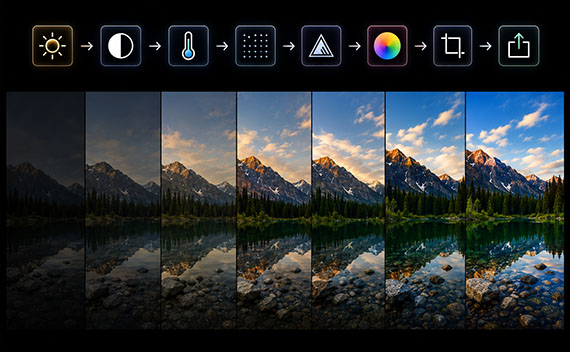
Every adjustment you make changes the underlying data in your image. That means the next adjustment isn’t working with the original photograph anymore—it’s working with a modified version of it. In some situations the difference is minor, but in others it can have a surprisingly large impact on image quality.
Think of a digital photo as a massive collection of brightness and color values. When you increase exposure, you are changing those values. When you add contrast, you’re stretching them apart. When you sharpen, you’re increasing edge contrast between neighboring pixels. Every editing tool is essentially manipulating data.
Because of this, the order of your edits can affect how much information is available to later adjustments.
A good example is noise reduction and sharpening. Noise reduction attempts to smooth unwanted variations in brightness and color, while sharpening enhances local contrast to make details appear crisper.
If you sharpen first, you’re not just sharpening details—you’re also sharpening the noise. Later, when you try to remove that noise, the software has a more difficult job because the unwanted artifacts have already been emphasized.
For this reason, noise reduction is usually most effective before sharpening.
Exposure and contrast adjustments offer another example. Imagine an image that is slightly underexposed. If you immediately apply a strong contrast adjustment, you may push shadow areas even darker. Later, when you attempt to recover those shadows, you may discover additional noise and reduced detail.
By correcting exposure first, you establish a stronger foundation for every adjustment that follows. The software has more balanced tonal information to work with, which often produces cleaner results.
Color adjustments follow a similar principle. White balance affects nearly every color value in the image. If you spend time fine-tuning colors and then make a major white balance correction afterward, much of your earlier work may need to be revisited.
This is why many photographers treat white balance as one of the first creative decisions in the editing process.
This doesn’t mean every photographer must follow an identical workflow. Different images and different creative goals may require a different approach. However, understanding how edits affect the underlying data can help you make smarter decisions when processing your photos.
The next time you’re editing an image, remember that photography isn’t just about choosing the right adjustments. It’s also about choosing the right sequence.
Great editing is often less about the sliders you move and more about the order in which you move them.
For Further Training:
Today’s sale on the Photo Editing Cheat Sheets is wrapping up soon, making this a great time to bring clarity to your editing workflow. If editing often feels scattered or uncertain, these cheat sheets provide a clear, repeatable process for tackling exposure, color, masking, retouching, and finishing touches in the right order.

Paired with time-saving keyboard shortcuts, they help you edit faster, stay consistent, and know when an image is truly finished.
Deal ending soon: The Photo Editing Cheat Sheets Flash Sale
from PictureCorrect https://ift.tt/4Mj3Kob
via IFTTT


0 kommenttia:
Lähetä kommentti