


There’s a common belief in photography that Milky Way images require thousands of dollars in camera gear. Full-frame cameras. Ultra-fast lenses. Star trackers. Exotic tripods. Endless accessories.
But the truth is a little different.
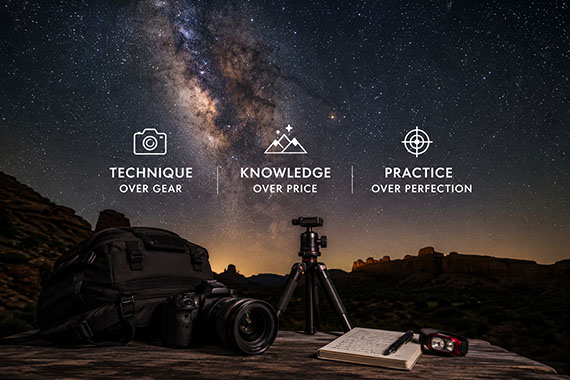
Expensive gear can absolutely make Milky Way photography easier. It can improve image quality, reduce noise, and give you more flexibility. But many photographers dramatically overestimate how much gear matters — especially compared to technique.
A photographer with excellent technique and mid-range gear will usually outperform someone with expensive equipment who lacks the fundamentals.
The biggest difference-maker in Milky Way photography is not the camera.
It’s knowing how to work with darkness.
Planning to shoot this season? The Milky Way Photography Field Guide is currently 70% off  —built to help you get sharp, detailed results without guesswork.
The Real Secret: Light Management
Night photography is fundamentally about controlling extremely limited light. The Milky Way is bright compared to deep space, but it is still surprisingly dim to a camera sensor.
Success comes from understanding how to gather and manage that light efficiently.
This means learning:
- How to expose without overexposing stars
- How to focus accurately in near-total darkness
- How to stabilize the camera properly
- How to balance ISO, shutter speed, and aperture
- How to avoid motion blur from Earth’s rotation
- How to work around noise limitations
- How to choose locations with minimal light pollution
- How to compose scenes that still look interesting at night
These skills matter far more than simply buying a more expensive camera body.
Technique Beats Sensor Size
One of the biggest myths in Milky Way photography is that you “need” full-frame gear.
Full-frame cameras are excellent for night photography. They generally perform better at high ISO values and can capture cleaner files in low light.
But crop-sensor cameras can still produce incredible Milky Way images.
In fact, many photographers create stunning night sky photos using APS-C cameras, Micro Four Thirds systems, and even smartphones.
What usually separates successful images from disappointing ones is not the sensor size — it’s whether the photographer understands exposure technique.
A poorly focused Milky Way shot from a $4,000 camera still looks bad.
A carefully exposed and well-composed image from an older camera can look fantastic.
Focus Is More Important Than Sharpness Specs
Photographers often obsess over lens sharpness charts and expensive optics for astrophotography.
But the reality is this:
Slightly soft stars caused by inaccurate focus ruin more Milky Way images than lens quality ever will.
Manual focus technique is critical at night because autofocus often struggles in darkness.
Many beginners rely on the infinity symbol on the lens barrel, but this is unreliable on modern lenses. Temperature changes and manufacturing tolerances can shift true infinity focus slightly.
Instead, experienced Milky Way photographers often:
- Use live view
- Zoom into a bright star digitally
- Slowly adjust focus manually
- Fine-tune until the star appears as small and sharp as possible
This single technique can improve your results more than upgrading your camera body.
Stability Matters More Than Fancy Features
You do not need a luxury tripod.
But you do need a stable tripod.
Long exposures magnify vibration. Even tiny movements can soften stars and reduce detail.
A basic sturdy tripod is often enough. What matters most is minimizing movement:
- Use a remote shutter or timer delay
- Avoid extending the center column unnecessarily
- Shield the setup from wind
- Let vibrations settle before exposing
- Turn off image stabilization when on a tripod
A technically perfect exposure from an older camera almost always beats a blurry exposure from a premium setup.
Understanding Exposure Changes Everything
Milky Way photography becomes dramatically easier once you understand exposure tradeoffs.
Many beginners simply raise ISO endlessly and hope for the best. But good night photography is usually about balancing three competing limitations:
- Motion blur from Earth’s rotation
- Noise from high ISO settings
- Light gathering from aperture size
This is why techniques like the 500 Rule became popular.
Maximum shutter speed ≈ 500 ÷ focal length (full-frame equivalent)
The rule helps estimate the longest shutter speed you can use before stars begin visibly streaking across the frame.
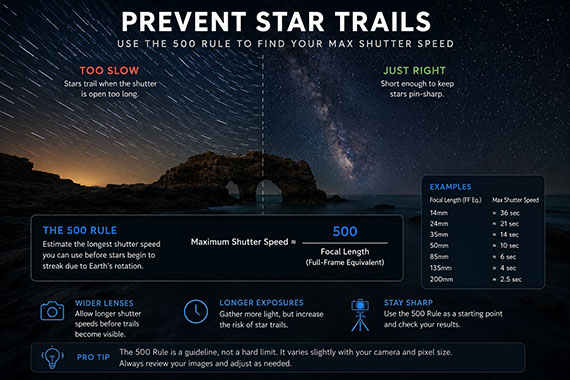
Even with modern alternatives like the NPF Rule, the important point remains the same:
Understanding exposure technique matters more than owning expensive equipment.
Editing Is Part of the Process
Many iconic Milky Way images are heavily refined during post-processing.
That does not mean they are fake.
Night sky photography naturally requires more editing because cameras struggle to capture scenes the same way human vision perceives them.
Good editing technique often includes:
- Noise reduction
- White balance adjustments
- Contrast refinement
- Local exposure adjustments
- Foreground blending
- Color correction
- Star enhancement
- Dehaze adjustments
A photographer who understands editing can dramatically improve results from older or less expensive gear.
Core Season Sale: Milky Way Photography Field Guide
If you want a simple, field-ready way to get all of this right, the Milky Way Photography Field Guide breaks it down step-by-step.
Inside, you’ll learn when the Milky Way is visible, where to look, how the galactic core moves across the sky, which camera settings to use, and photo editing tricks.
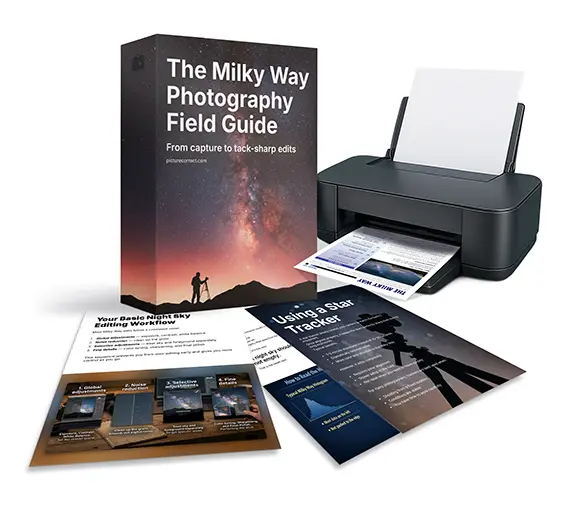
Right now, it’s part of our Core Season Sale—timed perfectly for the months when most photographers start planning their Milky Way shoots.
Deal ending soon: Milky Way Photography Field Guide Core Season Sale
from PictureCorrect https://ift.tt/IA8tclV
via IFTTT


0 kommenttia:
Lähetä kommentti